How to Store Weights in a Small Apartment
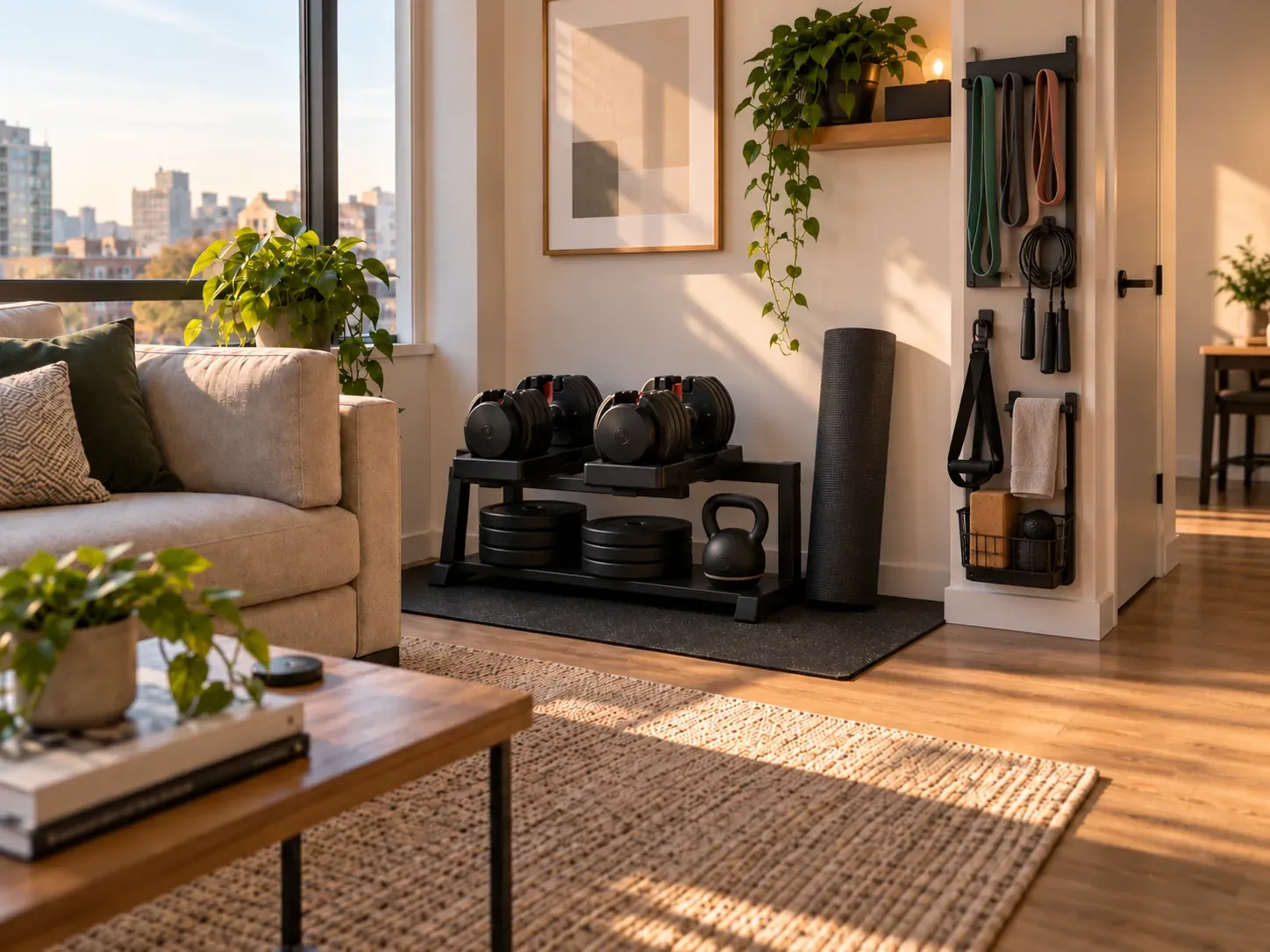
7 practical ways to keep heavy training gear organized without giving your living room over to the gym.
A pair of dumbbells does not take up much room. Until it lives beside the sofa.
Then a kettlebell joins it, a band gets left on the floor, and the mat stays rolled against the wall. The problem isn’t how much equipment you own — it’s how permanently it occupies the room.
Good storage gives heavy gear a fixed home and keeps what you use often within reach, so the room returns to normal when the workout ends. The goal is not to hide every piece of equipment — it is to make the gym disappear when you are not using it.
If you are still deciding what deserves space in the first place, start with 7 Pieces of Home Gym Equipment That Actually Fit in a Small Apartment.
Start With the Weight, Not the Container
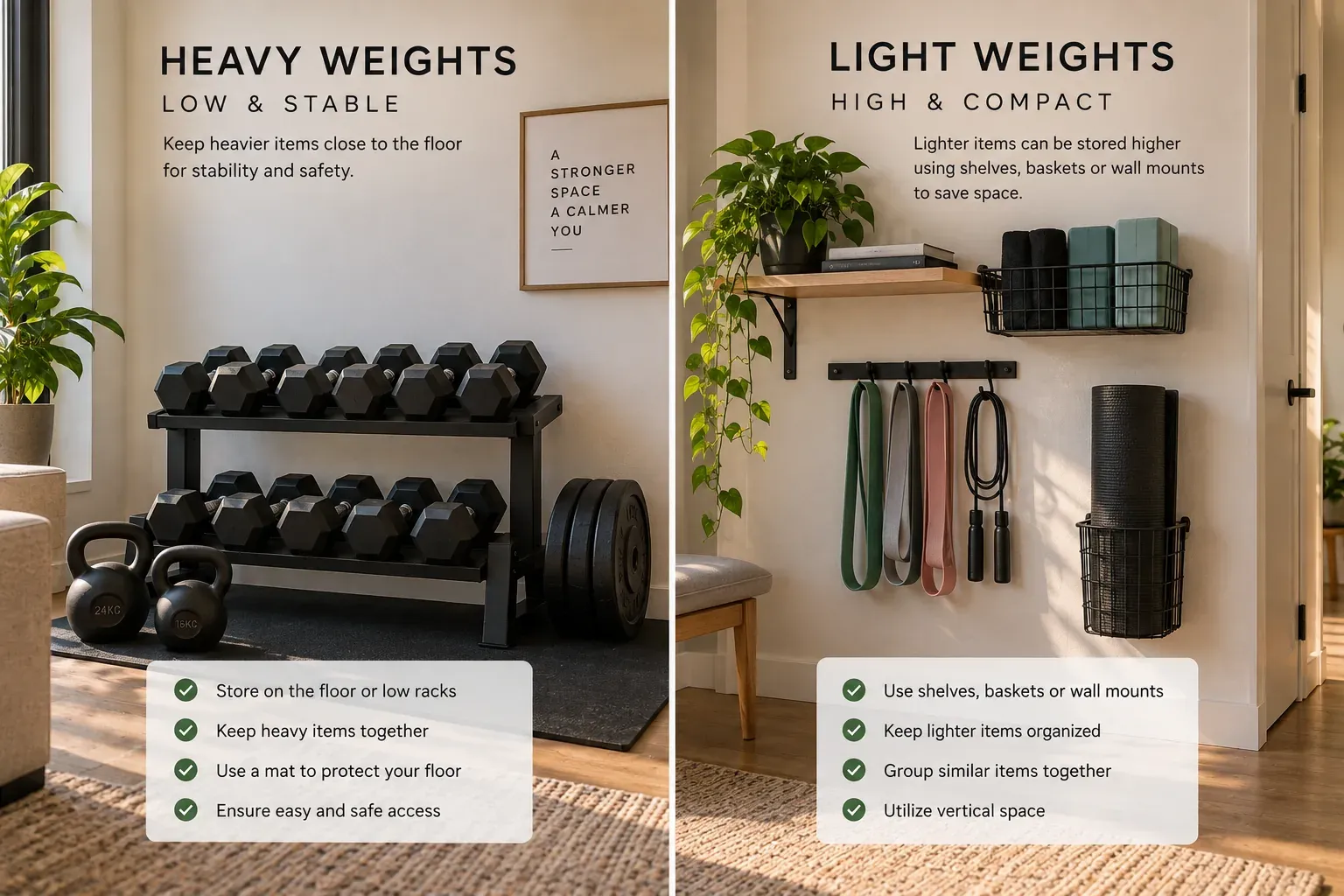
Heavy gear stays low. Light gear can go vertical. Frequently used gear stays accessible.
A resistance band weighs almost nothing; a loaded dumbbell does not — and that difference should decide where each item lives. Heavy equipment needs a stable, ground-level home; bands, straps and sliders can use vertical space, baskets or door storage instead. That one distinction solves more problems than buying another container.
7 Ways to Store Weights in a Small Apartment
Use a Compact Vertical Dumbbell Stand
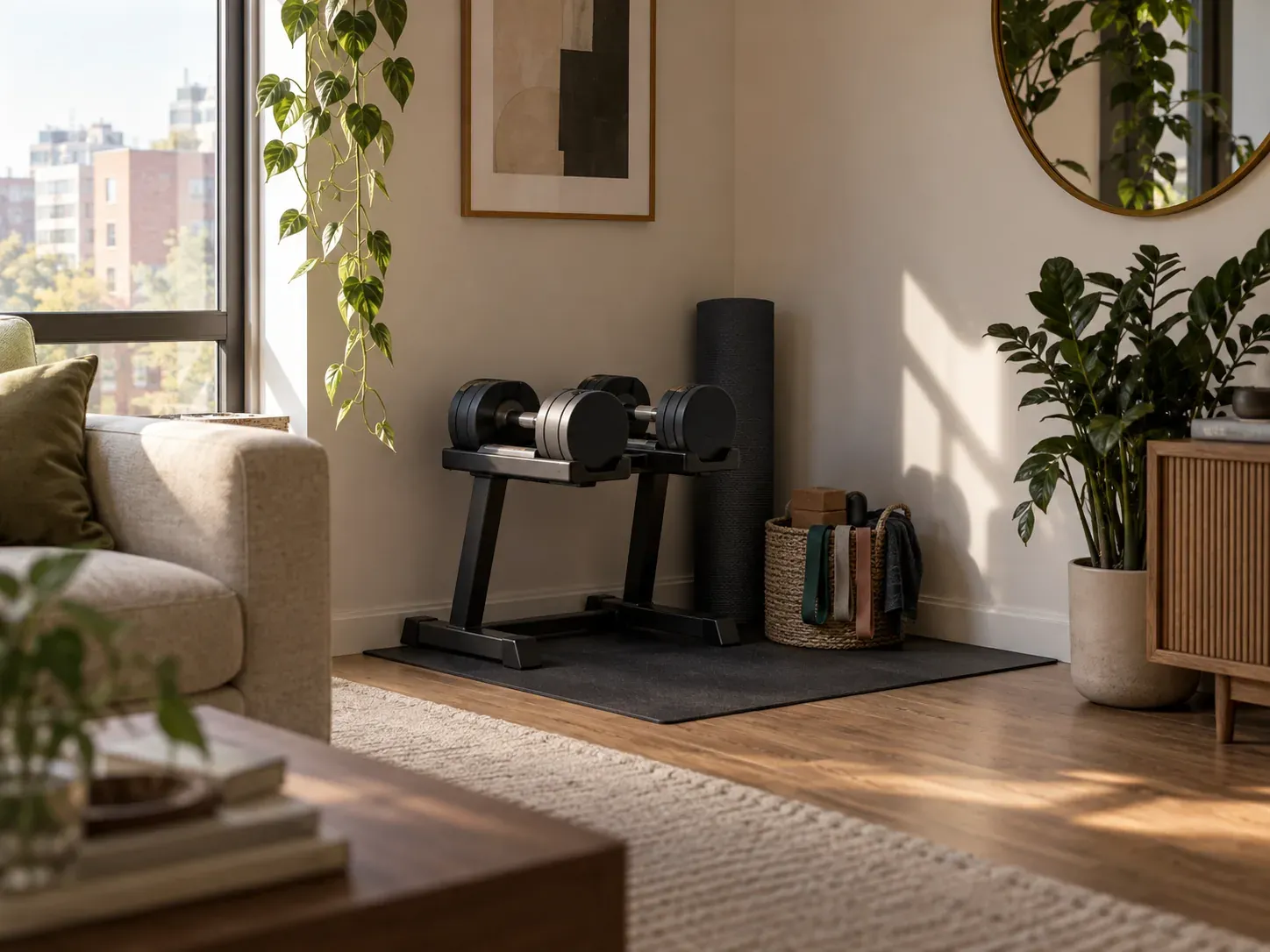
A horizontal rack makes sense in a commercial gym, but in a small apartment it can occupy more floor width than the dumbbells deserve. A compact vertical stand fixes that — organizing a small, fixed set upward instead of sideways, close to the ground.
Check the base’s footprint, its stated load capacity, and how easily you can remove a dumbbell without knocking into the others — then position it against a wall or the edge of your mat, not the middle of the room.
Let Adjustable Dumbbells Replace the Rack
Sometimes the best storage upgrade isn’t storage — it’s owning less equipment. A pair of adjustable dumbbells can replace several fixed pairs in roughly one station, so you’re just deciding where that one pair — and its base or cradle, if it uses one — belongs. If you haven’t picked a pair yet, see Adjustable Dumbbells for Small Apartments, Compared.
If your set uses a base or cradle, treat it as permanent, not packaging to discard — it keeps the plates or adjustment mechanism together and makes resetting quick. If you are still building the setup, equipment choice matters as much as storage; our guide to 7 Pieces of Home Gym Equipment That Actually Fit in a Small Apartment starts with that footprint-first approach.
Use Under-Bed or Under-Sofa Space for the Right Gear
The empty space under furniture looks like free storage, but not every weight belongs there. It works best for gear you don’t need every few minutes — small plates, lighter dumbbells, sliders, handles or accessories.
Measure the actual clearance first, then think about how the equipment comes back out — dragging a heavy dumbbell across the floor every session just trades one problem for another. The best spot isn’t the one that hides the most gear; it’s the one you’ll actually use.
Build One Dedicated Weight Corner
One controlled training corner beats equipment scattered across the apartment.
Spreading gear through the apartment — a dumbbell by the desk, bands on a chair, a mat behind the door — means everything is technically stored, but the gym now occupies the whole home.
Choose one corner instead: it doesn’t need to be large — an adjustable pair (and its base, if it uses one), a rolled mat, and a small basket for accessories is enough. The advantage is as psychological as physical, giving the gym a boundary so the rest of the room stays a room.
Use a Low Storage Rack That Is Actually Rated for the Load
A shelf and real weight storage aren’t the same thing — dense equipment concentrates load into a small area, which makes decorative furniture a bad place to improvise. Check what a low rack or cabinet is actually rated to support, and keep the heaviest items on the lowest level for stability and easier lifting.
A protective layer underneath also keeps a metal stand from marking the floor — and upstairs, that same floor contact affects how much noise travels down. If that’s part of your problem, see Quiet Home Gym Equipment for Upstairs Apartments for the equipment and surface choices that reduce it.
Put Light Accessories Up — Not Heavy Weights
Vertical space works only for what benefits from it — bands, straps, jump ropes and other light accessories do well overhead or on hooks, since they weigh almost nothing and otherwise turn into clutter. Heavy weights are different: you don’t need to mount dumbbells to a wall, and for renters, permanent wall storage usually creates more trouble than it solves.
A door anchor, over-door organizer or removable rack handles most of the light gear without a permanent installation. If drilling is off the table, How to Build a Home Gym Without Drilling Into Your Walls covers renter-friendly ways to build the rest of the setup.
Make the Reset Part of the Workout
The best apartment gym disappears when the workout ends.
The difference between a home gym that feels integrated and one that feels messy usually comes down to what happens after the final set. Build the reset into the session — dumbbells to their base or storage spot, bands to their hook or basket, the mat rolled or folded. None of it waits until later, and it takes minutes, not a second workout.
That habit matters because the floor you train on is usually the same floor you eat, work or relax on. A good apartment gym respects that.
Where You Shouldn't Store Heavy Weights
Saving space is not worth creating an unstable setup.
Avoid high shelves for dumbbells, kettlebells or plates: you shouldn't have to control a dense object above shoulder height every time you train.
Avoid narrow decorative furniture that isn't designed for the load.
Avoid the main walking path: keep weights away from a bed, sofa or doorway you move through without thinking.
Avoid repeatedly placing or dragging weights directly across delicate flooring.
The safest storage setup is usually also the simplest one: low, stable, predictable and easy to reset.
A Simple Weight-Storage Setup for Most Small Apartments
You do not need a dedicated storage wall — for most small apartments, the whole system fits inside one controlled corner.
HEAVY GEAR — Adjustable dumbbells or a small fixed set, kept on their original base (if they came with one) or a compact stand, set on a protective surface.
LIGHT ACCESSORIES — Bands, handles and straps, stored vertically or inside one small basket.
MAT — Rolled or folded beside the setup, not permanently covering the room.
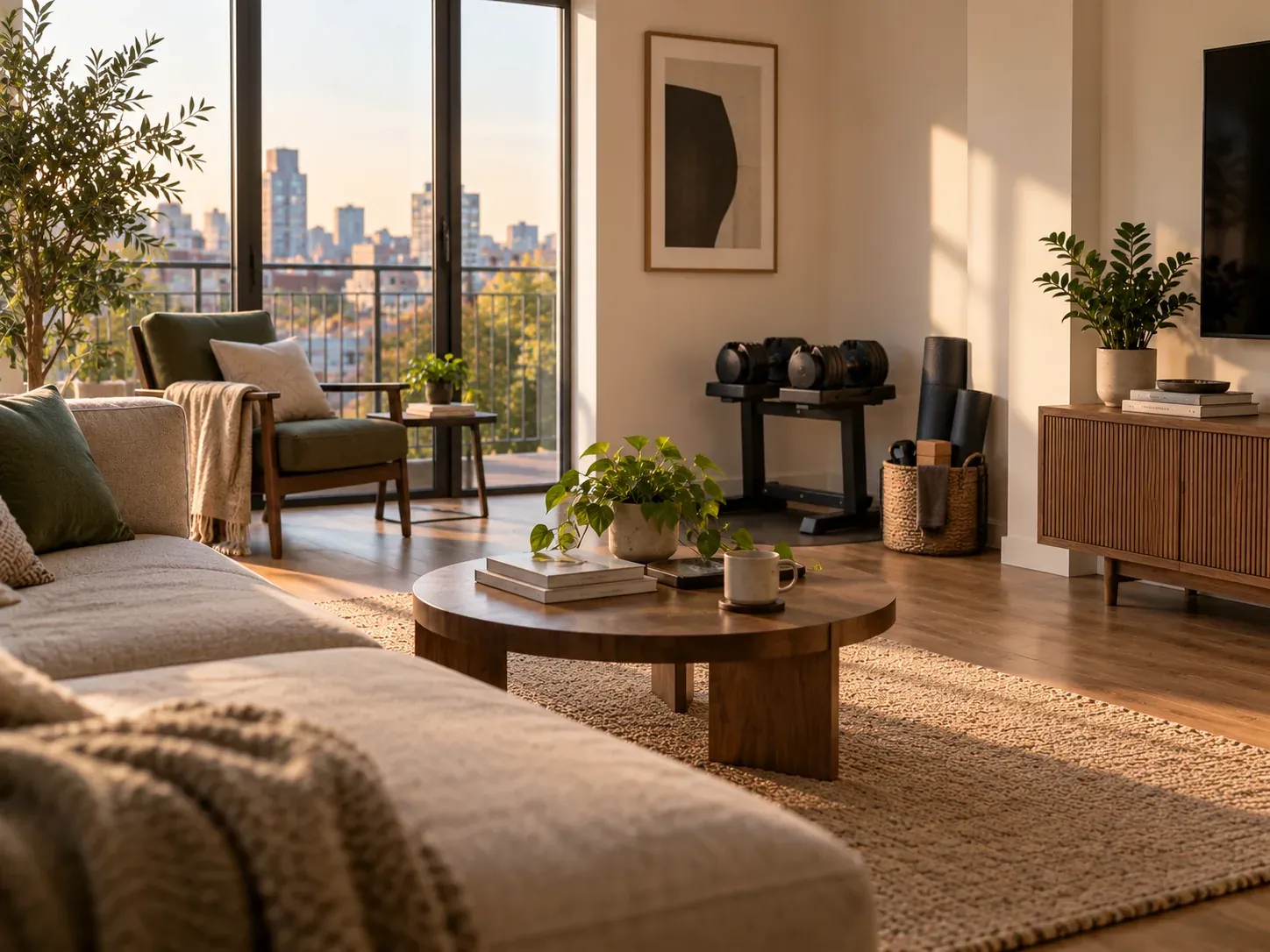
The result isn’t invisible — it’s contained. You still have a real strength setup when it’s time to train, but the room doesn’t have to look like a gym the rest of the day.
Small-space training gets easier when every piece of equipment earns both its training value and its footprint. The goal is not to fit more gear into the apartment. It is to make the equipment you actually use fit the way you live.